
One of the most common questions we ask when we meet a new person is, “What do you do?” People often tie their identity to their professional careers.
How we go about answering this question and dealing with the
changes that come as we approach and ultimately move into retirement from an
active career will require us to redefine that part of our identity. Aging will
also require us to address the natural changes in our physical and mental
abilities, as well as our relationships with the friends and colleagues in our
network with whom we spend time.
Yet these changes do not mean that living a fulfilling and
productive life will come to an end. In his book From Strength to Strength:
Finding Success, Happiness, and Deep Purpose in the Second Half of Life,
Arthur C. Brooks powerfully argues that our experience and the wisdom we have
gained over the years open up a world of new opportunities. To support this
point, Brooks draws on his behavioral science research, historical examples,
and personal experience.
Two Kinds of Intelligence
A foundational insight in Brooks's book comes from psychologist
Raymond Cattell's distinction between two kinds of intelligence: fluid and
crystallized.
Fluid intelligence is the ability to adapt to unfamiliar
situations, come up with solutions to novel problems, and process information
quickly. It may explain why so many technology startups are led by young
entrepreneurs. Research suggests that some aspects of fluid intelligence peak
in early adulthood and may gradually decline with age.
On the other hand, crystallized intelligence comes from the
experience and knowledge we have accumulated over the years. An older
professional may have the advantage of recognizing how a similar challenge was
addressed in the past, identifying potential pitfalls, and exercising sound
judgment. It is like a wise physician who can quickly diagnose an illness based
on symptoms seen many times before. Research shows that this type of
intelligence develops only over time through lived experience.
These strengths are not mutually exclusive; instead, they
transition over time. As they change, however, we have the opportunity to
leverage and use the emerging power of crystallized intelligence. As one
ancient proverb shares, “The glory of young men is their strength, but the
splendor of old men is their gray hair” (ESV).
Based on these insights, the next question is: How do we
support this transition from one strength to the next?
Moving Forward
As retirement approaches, we need to recalibrate our
identity and many other aspects of our lives. Retirement gives us the chance,
as Brooks recommends, to create a reverse bucket list that asks new questions,
such as: What is my purpose? How do I spend my time? Who needs me, and who do I
need?
The answer is not to fill our time with noise and social
media scrolling. Reaching retirement is not an opportunity to simply sleep late
every morning and sign up for streaming subscriptions to catch up on the shows
he may have missed.
Retirement will certainly provide more time for leisure, but
the reverse bucket list asks us to think carefully about which obligations and
practices we should stop doing. It is an opportunity to restructure our lives to
devote more time to relationships, service, and spiritual growth.
What Do We Want to Be Remembered For?
Closely connected to the reverse bucket list is the
distinction between résumé virtues and what Brooks calls eulogy virtues. Résumé
virtues are the accomplishments that help us succeed professionally: titles,
promotions, awards, and credentials. Professional achievements are worth
recognizing as a job well done.
However, eulogy virtues are the qualities we hope others
will remember about us: character, kindness, generosity, faithfulness, love,
and service. At the end of our lives, our family and friends will remember us
most for the relationships we had with them rather than for how many hours we
put in at work.
Three Recommendations for Building Our Crystallized
Strengths
As we enter the second half of life, Brooks offers recommendations
for making the years more meaningful. He highlights the opportunity to deepen
our spiritual lives, invest in relationships, and embrace our weaknesses.
1. Deepening Our Spiritual Lives
Brooks’s theme verse for the book is Psalm 84:7. It
describes pilgrims traveling toward Jerusalem, passing through difficult
terrain while drawing strength from God. “They go from strength to strength;
each one appears before God in Zion” (ESV). It pictures perseverance and
spiritual strength on our journey of faith.
During our working years, demands on our time can make it
difficult to maintain spiritual disciplines. However, fewer obligations in
retirement do not automatically eliminate these distractions. Entertainment, social
media, and even hobbies can quickly fill the hours once devoted to work.
Just as work required a disciplined approach, retirement
requires reevaluating how we spend our time. It offers the opportunity to
establish new habits and routines to enhance our spiritual lives through meditation,
prayer, sacred reading, and service to others.
2. Investing in Relationships
Another important theme in Brooks's book is the role of
relationships in achieving lasting happiness and fulfillment. During our
working years, we build many professional relationships. We interact with
colleagues, clients, and customers for mutual benefit. Brooks calls these “deal
friends.”
When we retire, our relationships with many of our “deal”
friends will fade away in the months and years that follow. However, retirement
provides the opportunity to intentionally find and develop the relationships
that Brooks calls “real” friends. These may mean reconnecting with family
members or friends from years ago, or building relationships with people who
share your interests and values now.
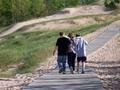
One illustration Brooks presents in his book to show the
power of relationships is the Pando aspen grove near Fish Lake in central Utah.
When you visit the Pando grove, as I have, it looks at first like a large group
of similar-looking trees. But in reality, all of the trees are tightly woven
together through an interconnected root system that supports them all.
Scientists say that the grove is one of the largest living organisms in the
world.
 |
| Pando Grove, Utah |
3. Embracing Our Weaknesses
Brooks's third recommendation may seem to be counterintuitive.
He acknowledges that as we age, we will experience changes in our physical and cognitive
abilities. Illness and injury will
impact our independence and the activities that we can do.
What we do control is how we react to these changes by
embracing these emerging weaknesses. Brooks uses the example of the Apostle
Paul to make this point. In 2 Corinthians 12, Paul, when confronted with the
thorn in the flesh, prays to God for relief. God's response to his request for
relief highlights the call to embrace weakness: “My grace is sufficient for
you, for my power is made perfect in weakness” (ESV). Even with his weakness,
Brooks notes that Paul can be defined as one of the greatest entrepreneurs in
history by planting the seeds for the worldwide spread of the Christian faith.
Conclusion
Brooks highlights both the challenges and opportunities that
come with aging and contemplating or starting retirement. The wisdom he shares
offers hope and a path forward for our later years. As we move from fluid to
crystallized intelligence, Brooks also offers practical encouragement about
steps we can take to embrace meaning in this stage of life.
His suggestions include mentoring a young person or student.
We can share the practical skills we have developed over the years, whether
woodworking, cooking, or family budgeting.
Another practical opportunity might be sharing and
preserving family history. This can include verbally sharing stories about our
family or documenting family trees online.
Perhaps most importantly, we can proactively invest in
relationships by getting involved in ministries and community activities, as
well as by regularly meeting with other retired friends.


 Posts


No comments:
Post a Comment