Speaking Engagements

The 2011 Membership Marketing Benchmarking Report Now Available as a Free Download

It is my pleasure to announce the release of the 2011 Membership Marketing Benchmarking Report. A free download of the full report is available, with site registration, using this link.

As readers of this blog know, this marks the third year that we have surveyed membership organizations to better understand the strategies and tactics used to recruit members, engage new members, renew existing members, and reinstate former members.

And each year we add questions to explore new areas of membership marketing. This year the report features new data on the practices around increasing membership dues, engaging members with products and services, membership chapters, and the key impediments that hold back membership growth.

Beyond cataloging membership practices, the Benchmarking Report also takes these practices and cross-tabulates them with the membership results membership groups are experiencing. The comparison of practices and outcomes in membership provides strong directional information on what strategies might be added or dropped to help improve an organization’s membership program.

I hope that you find the 2011 Report of help as you seek to maximize the membership results for your organization.

Six Components to Building Your Membership Model

Membership models are a hot topic these days. I am speaking with a number of clients about options on how to build new memberships or adapt current categories.

Instead of trying to build an exhaustive list of the different membership models now being deployed, I thought that it might be of more value to outline the components that go into and can be changed to form a new membership.

I have identified six levers that an organization can adjust in a membership product. By thinking through and making decisions in each of these areas you can define the membership model that best fits your organization and the needs in the market.

Here are the six elements that go into building a membership model.

1. Participants – Who do you want as participants in the membership? This can be defined as specific markets or market segments. It can also be defined as whether the membership is for individuals or groups of people in organizations or companies.

2. Value – What products and services are desired by your market that you are able to deliver to the membership? Providing value involves both understanding the need for content, community, savings, etc. and also your knowledge and ability to deliver what is needed.

3. Term – When do you want the membership to start and to end? For many organizations the standard term of membership is a year. But many memberships – like health clubs – offer a monthly membership term. Others require multiple years of membership tied to an event like certification

4. Fulfillment – Where do you want to deliver membership benefits? There is a growing shift from providing a paper based or in localized in-person membership to an electronic only membership.

5. Price – How much, if anything, do you want to charge for the membership? Memberships can range from tens of thousands of dollars to just a few dollars a year. And increasingly, the concept of ‘Freemium” membership is being tried by organizations where membership is used to build community or engagement as part of a larger economic strategy.

6. Purpose – Why do you want to create the membership? The ability to create a membership model and an economic plan to sustain it are very important in planning, but Tom Collins also points to doing what you are deeply passionate about as a foundation for success.

To build your new membership model, I suggest that you look at each of these membership components and list all of the options under each that are available to you. How you mix and match each of these options will form the outline for the membership model that best fits your organization and the needs in the marketplace.

Please feel free to post a comment here if you think that I have missed any important membership components here.

Yes Marketing Works

The other day, I received a comment from the CEO of an organization that basically said, “Hey, your marketing didn’t work”.

Marketing done properly provides statistically projectable outcomes that can be done with great precision. If variables are held constant, a mailing list or direct mail package that worked in the past will continue to perform more or less at a predictable level when you allow for some statistical flux.

For marketers, the challenge comes when you do not have a marketing history on which to build your projections. You do not know what lists, offers, messages, or timing are best for a given product or organization. It is like a doctor doing a diagnosis without any of the tools of modern medicine.

You need to set some goal or outline an expected return, so you use results gathered from similar organizations or experiences. You ground your projections with the best information that you have at the time.

But basing projections solely on other organizations and experiences is a very poor substitute for real response data. On any new product or client launch without historical data, you are jumping into the unknown. You are taking a risk. It usually is better to try something than to do nothing, but it is a risk.

You may hit a home run, but you also better be prepared to hear, “your marketing doesn’t work”.

Solutions to a Declining Membership

Back in April, I wrote a post titled, “What are the Biggest Impediments to Membership Growth?”

However, I did not talk through potential solutions to these impediments. So here we go with some thoughts on what to do about a declining membership.

I have been doing membership consulting for over twenty five years. During this time, I have noticed that organizations tend to react to membership declines with two types of responses.

The first response is to demand action now. An organization might say, “Our membership numbers are down. We need to send out emails tomorrow to get the numbers up for the month!”

The second reaction that I see is avoidance. “Our membership numbers are down. But I cannot get the staff, chapters, or board to do anything about it.”

Neither of these reactions tends to bring long term solutions to a membership problem. What I have found works best is to help an organization step back and see the big picture and then develop a systemic solution to fixing the problem.

A classic treatise that speaks to these organizational tendencies is a book by Peter Senge titled, The Fifth Discipline: The Art and Practice of The Learning Organization. In the book he applies the concept of systems thinking to help organizations respond effectively to the challenges that they face.

Systems thinking highlight the inadequacies from the response that says “do something now” or simply work harder to solve the problem. This organizational response generally results in just kicking the can down the road. System thinkers call this “just push harder” reaction “compensating feedback”. This is “when well intentioned interventions call forth responses from the system that offset the benefits of the intervention. We all know what it feels like to be facing compensating feedback – the harder you push, the harder the system pushes back; the more effort you expend trying to improve matters, the more effort seems to be required.”1

In fact, Senge maintains, “pushing harder and harder on familiar solutions, while fundamental problems persist or worsen, is a reliable indicator of nonsystemic thinking – what we often call the ‘what we need here is a bigger hammer’ syndrome.”2

Systems thinking also speak to the avoidance or victim response to organizational challenges by helping to uncover high leverage solutions to a problem.

A basic premise of The Fifth Discipline is that organizations, economies, and people naturally grow as long as the things preventing that growth are removed. Senge says, “Don’t push growth; remove the factors limiting growth.”

“Systems thinking shows that small, well-focused actions can sometimes produce significant, enduring improvements, if they’re in the right place. Systems thinkers refer to this principle as ‘leverage’. Tackling a difficult problem is often a matter of seeing where the high leverage lies, a change which – with a minimum of effort – would lead to lasting and significant improvement. The only problem is that high-leverage changes are usually highly nonobvious to most participants in the system.” 3

So from a practical perspective instead of treating just the symptoms of a membership problem or being in denial what should one do? How do you bring a systems thinking solution to the problem?

A tool that I recommend to help diagnose a membership challenge from a systems thinking perspective is using a concept called the membership lifecycle.

The lifecycle breaks down each stage of the membership relationship. What I find is the most membership problems exist in one of the five lifecycle stages of awareness, recruitment, engagement, renewal, or reinstatement. Identifying the root membership problem can lead to a highly leveraged or efficient solution.

You can download a free whitepaper that outlines this concept using this link.

There is hope for a declining membership. Don’t give up. Step back and identify the key impediment to growth and work on fixing that nonobvious problem first.

1. The Fifth Discipline: The Art & Practice of The Learning Organization, by Peter M. Senge, p 58.
2. Ibid. p. 61
3. Ibid. p 63-64

Using Market Segmentation in Membership Marketing

Everyone talks about the importance of market segmentation, but I find that not everyone knows what they mean when they use the term.

Let’s start out by saying that market segmentation is a tool not an end in and of itself. You use market segmentation to help accomplish an objective like improving response rates by targeting messages or providing differentiated value to a certain group of members to enhance retention.

So before jumping into segmentation, the first step is to define what you want to accomplish and then see if the tool of market segmentation will help you achieve your goal.

If you determine that segmenting your market is appropriate, then it is helpful to further define what segmentation will be practical and useful to accomplish your objective.

Here is one way to classify the segmentation options available.

1. Linear Segmentation – This is as simple as splitting your market into two groups. For example, it probably would not be practical to create hundreds of versions of a monthly print magazine, but you might create two versions to serve some natural split in your membership like students and professionals, owners and operators, manufacturers and distributors. You might describe this as a “one to two” segmentation strategy.

2. Group Segmentation – This segmentation splits your market into specific groups or buckets of people. For example, based on state and local issues, you might provide separate marking messages driven by geography to enhance relevance. Or your segmentation might be driven by categories of products previously purchased. You might describe this as a “one to some” segmentation strategy.

3. Granular Segmentation – This type of segmentation results in unlimited options for your market. For example, based on a purchasing history an algorithm can be built to push a shopping cart of specific items that would be customized for each individual – think Amazon book offerings. Each member could receive a unique offering based on their preferences or previous behavior. Many marketers describe this as a “one to one” marketing strategy.

Granular segmentation is obviously more complex than linear segmentation. But that does not mean that one is better than the other. Remember, as with any tool, the key is using the correct tool for the job.

Segmentation can add to incremental costs for marketing or servicing a member. It also takes time to craft and maintain variable messages, services, and fulfillment operations. So before embracing a segmentation model, it is wise to evaluate both the positive effects it could have and the added costs it will create.

What examples do you have of successful segmentation programs? Feel free to share them here.

Associations Report Jump in New Members, Renewals, and Total Membership Counts

Membership organizations reported a triple play in membership numbers in the soon to be released 2011 Membership Marketing Benchmarking Report.

From this year’s survey, which included 650 participating associations, the major indicators of membership health – total membership, new members acquired, and membership renewals – all showed substantial improvements from the previous year’s benchmarking report.

A total of 49% of respondents said that they had recorded an overall increase in members over the previous twelve months. This is a substantial jump over the 36% who reported membership growth the previous year (see chart).
Growth in new member recruitment appears to be a big driver in membership growth.  Of responding association executives, 57% report the acquisition of new members increased over the past year.  These results are significantly better compared to both 2010 and 2009.
Finally, the survey results also highlight that membership renewals had a more positive outcome this past year with 32% of respondents saying that they have had an increase in overall renewal rates.

The 2011 Membership Marketing Benchmarking Report will be released on August 6th with full results being provided to survey participants.

Building Your Membership on Solid Ground

How can you build a sustainable membership? Here is one way of going about it. Build your organization around an idea instead of around a specific product or around a specific job or industry.

This type of foundation may explain why IBM is enjoying its 100th anniversary – an unusual feat in the rapidly changing technology world.

“IBM’s secret is that it is built around an idea that transcends any particular product or technology. Its strategy is to package technology for use by businesses. At first this meant making punch-card tabulators, but IBM moved on to magnetic-tape systems, mainframes, PCs, and most recently services and consulting. Building a company around an idea, rather than a specific technology, makes it easier to adapt when industry ‘platforms shirts’ occur.”1.

Interestingly, as I observe organizations that I have worked with over the years, I can see the good outcomes using this concept. Many of the memberships that are tied directly to a profession -- like the American Society of Professional (Fill in the Name) – have risen and fallen with the profession. But groups that are tied to a concept like curriculum, medical information, or quality have seen expansion over the past decade.

The story that I quoted from above was published in The Economist. Here is their concept; they were “founded in 1843, with the idea of explaining the world to its readers.” That is a need which will never go away. 

As the speed of change increases, think in terms of transcendent ideas and concepts as you build your membership value proposition instead of the latest trend. Build on solid ground instead of sinking sand.

1. The Economist, The Test of Time, June 11-17, 2011, p 20.
2. Ibid.

Consumer Use of Email Declines, but Association Deployment Remains Constant

In a time when some data indicates that email usage is declining, it appears that the use of email in membership marketing has remained stable this past year.

The 2010 U.S. Digital Year in Review Report showed that “Web-based email is waning: Total usage of web-based email dropped 9% in 2010 with more precipitous declines occurring among younger age groups, particularly teenagers. It’s clear that communication is shifting not only to other platforms, but to other devices. (If you plan to email your kids and you want a response, be sure to send them a text.)”1.

In our 2011 Membership Marketing Benchmarking research, we again asked where email was used in the marketing process. Respondents reported a small increase in using email to build awareness among prospects. They showed little change in using email to engage or onboard new members and support renewal efforts from the previous year. This follows a substantial growth in the use of email from 2009 to 2010.

Obviously, these two studies are drawing from completely different sets of data. However, if the trend line for web-based email is in decline, and since there is such a heavy reliance on email in membership marketing, it may be a warning that alternative channels need to be developed.

For example, the use of somewhat newer online marketing channels is taken advantage of by a minority of membership organizations. Only 13.6% of respondents report that prospective members become aware of their organizations through search engine ads and only 11.9% of respondents used paid advertising on other organizations websites to build awareness.

What results are you seeing in email usage for your organization? Feel free to share.

1. The Top 10 Digital Media Trends of 2010, By Linda Abraham - February 9, 2011

What Level of Engagement Do Members Really have with their Association?

Everyone would agree that a critical opportunity for associations is to engage members as customers of the products and services made available by an association.

But we wondered what proportion of members typically purchased or engaged the association each year through some type of product, service, or activity. To find out, we included the following question in our 2011 Membership Marketing Benchmarking research.
“What proportion of your members do you estimate engage with your organization in the following areas EACH YEAR?”
The chart below highlights the average percentage of members who used or were involved with each product offering. Some members may have used just one product others may have participated in every engagement opportunity. So this data does not show a cumulative level of engagement, but a product by product level of usage.


What stands out to me is the relatively low level of usage members have with the products and services offered by associations. Is it fair to say that members may be primarily members for the products and services that membership includes? What do you think?

What are the Biggest Impediments to Membership Growth?

I have often wondered what are the biggest challenges for organizations in growing their membership. So this year we asked association executives in our Membership Marketing Benchmarking research to tell us. And 631 unique associations answered the question.

Then we took their answers on the biggest challenges they faced and cross tabulated them with the reported membership performance for their organizations over the past five years. Did membership increase over this time period, stay the same, or decrease.

What we wanted to know was which challenges hurt membership growth the most and which were painful, but tended not to impede growth.

Here is what we found.


The data seems to indicate that if your organization has weak product and service offerings, an insufficient budget, or a lack of marketing expertise then membership growth has been not been achieved.

And if an organization suffers from the lack of a strategy or plan, then membership has been more likely to remain static.

However, there may be hope for membership growth even if an organization is faced with insufficient staff, market saturation, an inadequate association management database, or inadequate research to understand the market they serve as the biggest challenges. Organizations reporting these problems were more likely to see membership growth over the past five years.

What might be your theories to explain these outcomes? Does this data surprise you?

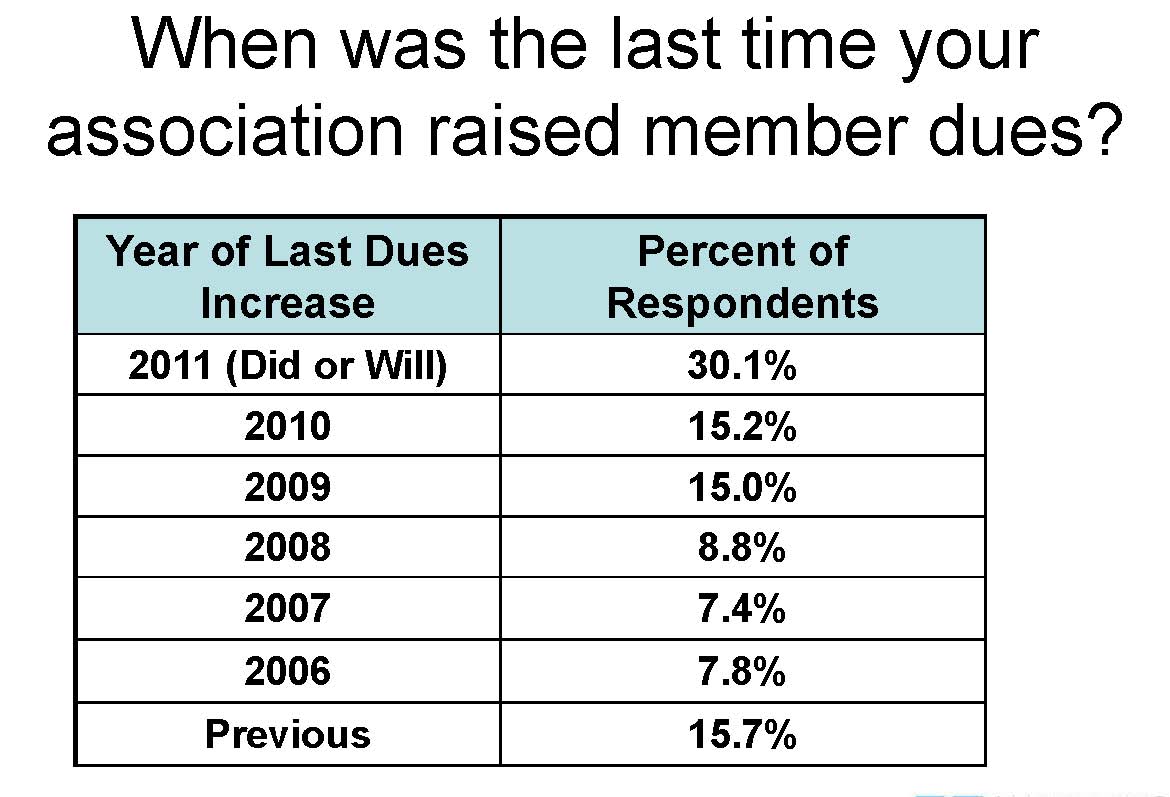
Current Practices in Increasing Membership Dues

We have started to work our way through the crosstabs for the 2011 Membership Marketing Benchmarking Report and some great data is showing up from the responses provided by the 650 participating associations.

Analyzing Two Volumes of Great Data
 This week I have had a number of questions asked about dues increases and since we included questions on membership dues this year, I wanted to share some top line responses from the survey data.

In our research, we asked: “How often does your association raise membership dues?”, “When was the last time your association raised membership dues?” and “What was the average percentage of your last membership dues increase across all membership categories?”

Here is how participations responded.


These dues related questions were also included in our 2007 Membership Dues Increase Study. So in addition to cross tabulating responses with membership outcomes, we will also provide some trend data in our benchmarking report.

By the way, participating organizations in this year’s research will receive their copy of the Membership Marketing Benchmarking Report in a few months.

Pricing Your Product, Service or Membership

Sometimes pricing is an afterthought when developing a product or service or changing your membership structure. But this can be a mistake. Pricing is one of the four “P’s” of marketing for a reason. Proper pricing has a huge influence on the viability and profitability of an offering and should be part of the conversation from the very start of product development.

For example, a quick search for a pair of sneakers shows a price range from $6.99 to $2,395. Clearly, there are vastly different strategies between these two ends of the pricing spectrum.

So how does one go about building a pricing strategy? Here are five basic approaches to pricing.

1. Cost-Plus Pricing: A price established to cover costs plus a margin added for profit. This method is not unlike that used in regulated industries like utilities.

2. Market-Oriented Pricing: A price based on the levels charged for similar products in the marketplace. Automobile companies are keenly aware of the price for completive vehicles. Perhaps in part because of this competition, car prices have risen at a much slower rate than inflation over time.

3. Market-Penetration Pricing: A low price to position a product to gain market share. An example of this might be the deals offered by telecommunication and cable companies seeking new customers. The price starts low and then goes up after a year or two.

4. Premium Pricing: A luxury price is designed to convey extreme value and exclusivity. Some people only want to buy the very best and are willing, for example, to pay $47,500 for a Rolex watch.

5. Value-Based Pricing: A price established based on the actual or perceived value a customer places on the product. This method requires a lot more work to set a price, but done properly it can also lead to better profits.

A book that does a good job explaining the value-based pricing strategy is The 1% Windfall: How Successful Companies Use Price to Profit and Grow. The book makes the point that successfully adding just a 1 percent price increase can produce a ten-fold increase in profits.

How does your organization set prices? Do you have a strategy or make it up as you go along? Feel free to share your thoughts.

Sample Marketing Language for Automatic Membership Renewals

One method to improve renewal rates is offering members the option for automatic credit card renewals. I get a lot of questions about this, so I thought it might be of help to provide some sample language you can use to present this option on recruitment and renewal efforts.
“[ ] Yes, I want to join or renew. Charge my credit card and provide my membership benefits with automatic renewal for as long as I wish to continue. See below for details.

As a credit card member, we will continue your membership as long as you wish without interruption, unless you tell us otherwise. At the end of your initial term, and before the start of your new term, we will simply charge your credit card at in the dues rate then in effect. Should terms or rates change, we will notify you in advance. If we cannot charge your credit card we will send you a bill for your dues.”
This language is provided as a sample only. The goal of automatic renewal is to transform the renewal process from being opt-in to an opt-out. This language also allows for a billing option once the credit card has expired.

Innovation through Collaboration

We are always looking for new innovative ways to do things better. So I wanted to share two items that I came across this week that attribute successful innovation to collaboration.

First in an article in the Technology section of the Washington Post, the case is made that much of the economic dynamism of technology companies comes from sharing talent and ideas. “Across the Internet industry, the most successful organizations compete by cooperating. It’s a modern strategy based on two assumptions. First, innovation is collaborative. Second, the rapidly expanding market of online products is limitless. Businesses that focus on the process of free-wheeling creation – rather than squashing the competition – gain dominance and profit.”1.

Along the same lines, Edward Glaeser, author of "Triumph of the City”, also believes in the power of collaboration, but he sees this collaboration arising not out of sharing, but because of the physical proximity of people to each other in a city environment. He says, “So much of what humankind has achieved over the past three millennia has come out of the remarkable collaborative creations that come out of cities. We are a social species. We come out of the womb with the ability to sop up information from people around us. It's almost our defining characteristic as creatures. And cities play to that strength. Cities enable us to learn from other people. They enable us to become better, in a sense, by leveraging the talent of the crowds around us. When you think about all the great inventions that human beings have made -- from Athenian philosophy to Henry Ford's Model T's, to Facebook -- they were always collaborative.”2.

From my own personal experience, I find that if I can get a bunch of smart people in a room, we can innovate much faster and better than any other process that I have employed.

One suggestion for collaboration in membership marketing would be to participate in this year’s benchmarking research. If you want to be part of the research, please use this link.

Where do you find your place to innovate through collaboration?

1. Greg Ferenstein, In a cutthroat world, some Web giants thrive by cooperating, The Washington Post, February 19, 2011.
2. Edward Glaeser, "Triumph of the City: How Our Greatest Invention Makes Us Richer, Smarter, Greener, Healthier, and Happier." Penguin Press

Why Hire a Marketing Agency?

To outsource or not to outsource is often a hot topic within many associations and membership organizations.

The arguments on why current staff should do the job are pretty well know, so I wanted to share some reasons why I believe it can make good sense to bring onboard a marketing agency. Here are five opportunities presented by through an agency.

1. To Bring Perspective and Objectivity – Just as an individuals can benefit from a counselor or coach, there also are situations where an outside perspective is very helpful for an organization. A marketing agency can bring an objective eye to help an association work through issues that are complex, controversial or politically sensitive.

2. To Provide a Proven Methodology – Does it really make sense to reinvent the marketing wheel? There are proven marketing solutions that agencies have developed and tested that can be rolled out right now. By hiring an agency, you can leverage the methodology of these solutions at a fraction of the cost that it would take you to develop them alone. An agency with the right experience may have the right tool at the right time for the job you need done right now.

3. To Raise Accountability – There are times in every organization when the urgent distracts from the important and key goals are not accomplished. Hiring a properly qualified marketing agency with clear definitions of scope and outcomes can bring focus and accountability to a task and get the important item done on time and on schedule.

4. To Supplement Existing Staff – There are times when the workload is just too much for an existing staff to handle. It might be because of vacancies, special projects, or large events. Theoretically, an association could carry staff for these situations, but this might add extra costs for salary, benefits, computers and software, office space, and recruitment or severance. A marketing agency can join your team to help your staff through this time and move on to the next assignment when the crunch is over.

5. To Share Specialized Knowledge or Skills – If you need surgery, you look for the doctor that has done the procedure the most times. You want the doctor with the best specialized skills and knowledge. That’s because no one can be an expert in everything. However, a strong marketing agency is composed of top specialists with very specific skills ranging from print production management, to media and list research, to online advertising lead generation. So when there is an important assignment or program that requires a specific knowledge or skill set, a marketing agency with specialists who have successfully accomplished the assignment dozens of times might be just what the doctor ordered.

If bringing a marketing agency on board is something that you want to consider, I have one other piece of advice. Please remember that hiring a marketing agency is not a commodity purchase.

To find the right agency you will find having a dialogue with candidates much more productive than issuing an RFP. I understand the need for an RFP process and I do get some that are excellent. So this post in no way is meant as a criticism or critique of any RFP that I have received.

However, I have seen much better outcomes for both clients and agencies when the parties meet with each other and help define the specific challenges and needs and then jointly build an appropriate solution.

Full disclosure, I obviously manage a marketing agency and therefore have an opinion on this subject. So I am curious to hear from you. Do you agree or disagree on the benefits of hiring a marketing agency or the process of entering into a relationship? Feel free to post your thoughts.

Open Community: A Little Book of Big Ideas for Associations Navigating the Social Web

Okay, I have to admit that when I got to page 21 and I was reading about “embracing the ecosystem” and “empowering the periphery”, I almost gave up reading Open Community: A Little Book of Big Ideas for Associations Navigating the Social Web” by Lindy Dreyer and Maddie Grant.

But I stuck with it and I am glad that I did. Because as I continued to read , I found the book to be a very practical and constructive guide on how to go about starting and developing a social media strategy for an association.

The book provides a step by step road map on how to start by listening to the market, building an organizational consensus around the purpose, and launching low risk efforts to see what works best.

But what I particularly appreciate about Open Community is the clear call to purpose and focus for social media.

The book makes clear “that just using social media for the sake of having a Facebook Page or a Twitter account just doesn’t make sense. There has to be a real, ‘show me the ROI’ reason to start and some business intelligence backing that up.”1. 

Open Community also emphasizes building a value proposition around your social media strategy. “The most important question is this: What can your members get from your social spaces that they can’t get anywhere else? If you can’t answer that question, start over.”2. 

Finally, the book highlights some of the add-on benefits social media provides to an association like empowering members to champion the organization to others and providing staff with real time feedback on association events, marketing, and content.

There is one thing that I think would make the book more helpful – maybe Lindy and Maddie are setting us up for a sequel. It is great to say a social media strategy needs to have an ROI focus and a clear value proposition, but it is another thing to do it. I think that even though every situation will be different, the book would have benefited from some case studies that highlight the ROI and value that associations have achieved by deploying a successful social media strategy.

The bottom line is that if starting or improving your social media strategy is part of the plan for 2011, then it is well worth buying, reading, and using the ideas in Open Community.

1. Lindy Dreyer and Maddie Grant, CAE, Open Community: A Little Book of Big Ideas for Associations Navigating the Social Web, 2010, page 40.
2. Ibid. page 140.

3 Tips on How to Improve the Presentation of Your Membership Product

Whether it is a meal at a restaurant, a theatric performance, or a piece of art, presentation is important.

How membership is presented is also important when promoting to prospective members.

So when I came across some behavioral concepts from the consumer market in the Mckinsey Quarterly magazine, I thought that they could be applied to how we market and present our membership product.  Here they are. 

1. Offering payment terms – Many organizations find that adding a bill-me to a membership promotion or offering installment billing can improve responses. In fact, over 45% of associations report that they now offer a dues installment payment option. Similarly “retailers know that allowing consumers to delay payment can dramatically increase their willingness to buy. One reason delayed payments work is perfectly logical: the time value of money makes future payments less costly than immediate ones. But there is a second, less rational basis for this phenomenon. Payments, like all losses, are viscerally unpleasant. But emotions experienced in the present—now—are especially important. Even small delays in payment can soften the immediate sting of parting with your money and remove an important barrier to purchase.”1.

2. Offering a tiered membership with lower and higher priced options – I have commented in the past on the benefits of developing a tiered (or multi-level) membership product. These tiers allow a member to pick the best value for themselves and allow the organization to maximize its share of wallet. As an example from the retail world, “many restaurants find that the second-most-expensive bottle of wine is very popular—and so is the second-cheapest. Customers who buy the former feel they are getting something special but not going over the top. Those who buy the latter feel they are getting a bargain but not being cheap.” 2.

3. Bundling diverse additional services into a membership package – The opposite problem of having only one membership category is having a membership with lots of choices like interest sections, local chapters, and optional periodicals. This complexity can actually reduce response rates. In fact, “reducing the number of options makes people likelier not only to reach a decision but also to feel more satisfied with their choice.”3.

Trying new ways to present membership really comes down to making the buying decision easier for a prospective member. We make it easier for them to buy if we offer payment over time and if we give a member a product that both meets a member's diverse needs, but also is not too complex or cumbersome to purchase.

What other suggestions do you have to better present membership in your organization?

1. Ned Welch, A marketer’s guide to behavioral economics, McKinsey Quarterly, February 2010.
2. Ibid.
3. Ibid.

3 Membership Marketing New Year’s Resolutions

The start of the New Year is a good time to step back and look at the big picture and put in place some initiatives that can really make a difference. So here are three resolutions that you may want to make for a more successful membership year in 2011.

1. Adequately Fund Membership Marketing – Just like putting money into retirement savings, investing in membership pays dividends for years to come. A new member produces a long term income stream. However, as I meet with membership organizations, I am continually surprised at the budgets that have been set aside for marketing. Almost every organization wants to grow their membership, but rarely do I see budgets that are tied to the lifetime value of a potential member. Lack of funding means many organizations are leaving money on the table and missing their potential by not crunching the numbers to determine how much they should be investing in getting more members.

2. Initiate and Cultivate Potential Member Relationships – We find that a promotion sent to a prospective member who provided an opt-in to receive more information from an organization will garner up to four times the response than the next best list. To gather this opt-in, we offer free content from our clients in exchange for contact information (an opt-in). The content offer may be presented through SEM, online ads, or to visitors to the organizations website or social media sites. The key is to initiate the lead and then cultivate the relationship.

3. Test and Track Membership Marketing Efforts – If you want to double or triple your marketing returns over the next year, then setting up marketing tests with a control and test cell is your best opportunity. You can test what marketing list is most responsive, what message is most compelling, and what offer best encourages action. To test you need to code the outbound marketing pieces and track the responses as they are returned. To capture un-coded responses, match back returns to your promotion file.

These membership marketing resolutions are summed up well by a comment from one of my survey respondent who wrote:

“When you actually do a recruitment campaign, they join. When you engage with your members, they stay. When you analyze the data, you find a nugget of information that can change all of your preconceived ideas.”

What are your membership marketing resolutions for 2011?

Can We Talk? Join an Interactive Discussion on the Membership Marketing Benchmarking Report

For those readers located in the Baltimore/Washington metropolitan area, I wanted to invite you to attend an interactive session that I am leading for the Maryland Society of Association Executives discussing the results from our Membership Marketing Benchmarking Report.

The meeting is on Wednesday, January 12th. If you have read the report and have comments or questions or simply want to learn more about the research, you can sign up using this link.

How Long does the Average Member Stay with an Association?

There is actually a formula to calculate how long members on average continue their membership. It is called calculating the Average Tenure of a member.

Here is how you can calculate this for your membership. Take the lapse rate of the membership (the opposite of the renewal rate) in a decimal form and divide it into the number 1. So a membership organization with an 80% renewal rate would have a lapse rate of 20% and an average tenure of five years (1/.20= 5).

Another way of looking at this calculation is if you have a 20% lapse rate, your membership will turn over every five years.

So what would be the “average”, Average Tenure for membership organizations?

In our 2010 Membership Marketing Benchmarking Report with over 400 participating associations, our average renewal rate was 83%. So this would put the Average Tenure of a member at 5.88 years for the participating organizations.

Please be aware that this is an average for the participating organizations. Some reported renewal rates less than 50% and others more than 90%.

Knowing the Average Tenure of your membership is a crucial data point to use in marketing planning and making long term budget projections.