Quick Findings on Membership Dues Increases
The Impact of a Membership Dues Increase on Renewal Rates
Some data from our recent Membership Marketing Benchmarking Report supports this premise. For example, 82% of organizations that raised dues by between 1% and 10% reported renewal rates of 70% or better after the increase. Similarly, 83% of organizations that raised dues by between 11% and 20% also report renewal rates of 70% or better after the increase.
However, this pattern falls apart with dues increases over 21%. In this case, only 68% of organizations that raised dues by more than 21% reported renewal rates of 70% or better.
The chart below provides the data on percent of dues increase and renewal rates.
The bottom line -- based on the the aggregate data -- it appears if an organization can keep a dues increase to under 20% there will not be a drop in overall renewal rates. But going over a 20% dues increase may errode renewal numbers.
Current Practices in Increasing Membership Dues
| Analyzing Two Volumes of Great Data |
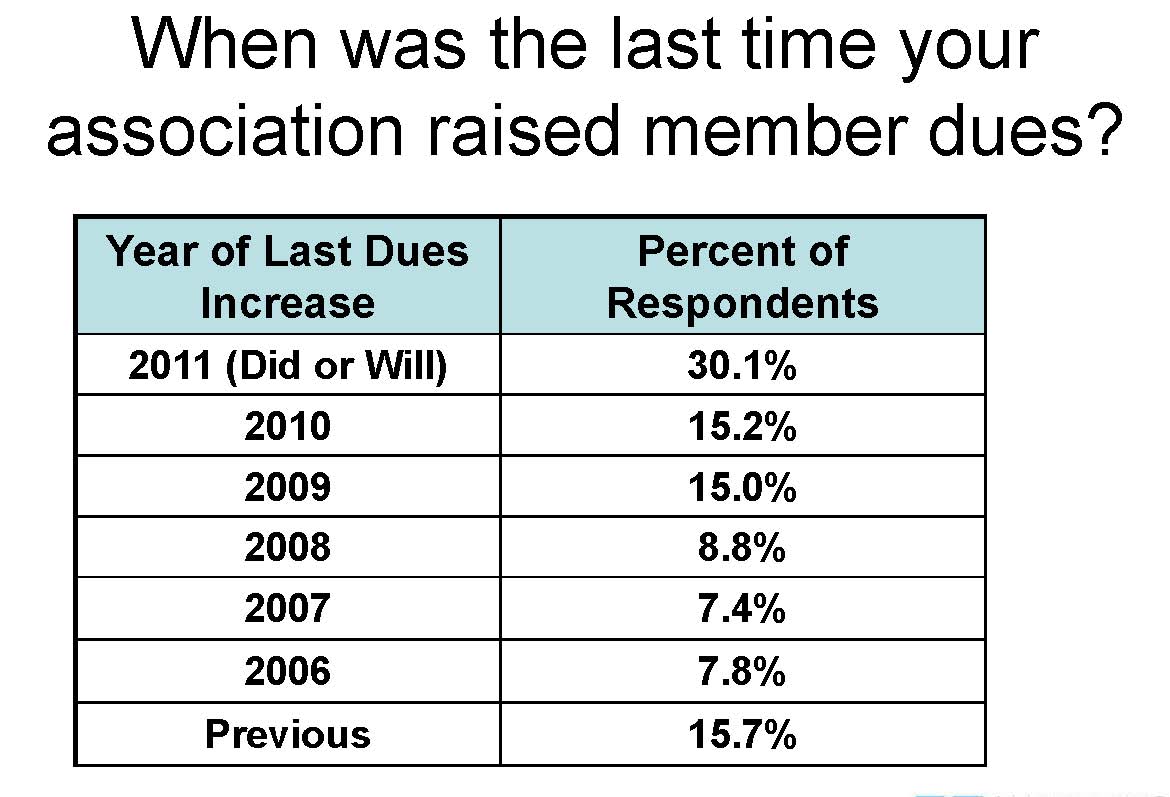
In our research, we asked: “How often does your association raise membership dues?”, “When was the last time your association raised membership dues?” and “What was the average percentage of your last membership dues increase across all membership categories?”
Here is how participations responded.
Supply and Demand Applied to Membership Marketing
With gas prices up and down, we are hearing a lot these days about supply and demand. So I was thinking, how does supply and demand play out with membership marketing?
Here are three observations.
- Demand for membership renewals is fairly inelastic. Meaning a percentage increase in dues rates generally does not translate into an equal or greater percentage drop in renewals rates.
- Demand for membership acquisition is more elastic. Meaning a percentage dues discount usually translates into more members.
- Membership supply is very elastic. Meaning it is easy to increase the number of member benefits (i.e. magazines) to meet increased demand.
What implications does this have for your 2009 planning?
- You may have room to increase dues rates on renewing members.
- You may want to try a dues discount to encourage new members to join.
- You can quickly and easily meet an increase in demand for more memberships, so push growth.
Let me know if you agree with these observations.
Article in the Association Forum of Chicago Magazine
Does Wal-Mart Announce a Price Increase?
So last week while I was working on an article about pricing for the March issue of FORUM magazine of the Association Forum of Chicagoland, I dove back into the data from our Dues Increase Survey. I compared associations that said they announced and justified a dues increase to members to those who did not announce it or attempt to justify it.
The survey supports that silence may indeed be golden. It turns out that associations who raised dues but gave members no justification (i.e. to pay for new programs or advocacy) for the dues increase and those that did not make an announcement about the increase where more likely to subsequently see membership grow compared to any other option.
For example, groups that gave no justification were 33% more likely to see membership grow than those who justified the increase to support additional advocacy. And groups who made no announcement of a dues increase were 84% more likely to see membership grow compared to those who announced the increase at their annual convention.
For those of you who never want to hear about the dues increase research again, I promise to move on to other topics. For those who want a copy of the research, send me an email and I will provide it to you.
More Dues Increase Findings

I wanted to share a few more items related to the dues increase survey research that we conducted this fall.
First let’s take a look at how associations justify raising dues to their members?
- 54% of associations indicate keeping up with inflation is the justification used to support the dues increase.
- 48% report that the addition of new programs or services is the justification used to support the increase.
- Close to one-quarter mention increasing advocacy as justification for an increase in dues.
Directionally, the proportion of associations offering inflation as justification for a dues increase decreases as the percentage of the dues increase grows. However, associations citing the additions of new programs and services are significantly more likely to raise dues 11% to 20% and to have provided a special offer as an incentive to renew.
Next, let’s look at how the dues increase announced to members?
- 44% of associations have announced their most recent dues increase through a letter or e-mail to the association and/or through a letter in the renewal notice.
- 40% of associations announced the increase through an article in the association newsletter or publication.
- If the announcement was made via some form of written communication, associations are significantly more likely to provide a special offer for joining/renewing.
Finally, here is how associations handled the timing of the dues increase and notification of members.
- About one-half of the associations made the dues increase known to the membership within three months of it taking effect.
- 30% of associations announced the change in dues four to six months before it was implemented.
- Only about 10% of associations made members aware of the increase a minimum of six months ahead of time.
- Associations planning to raise dues by 21% to 30% are more likely to announce this increase much further in advance.
- Only about 16% of associations provided some type of special offer to lessen the impact of the dues increase. Those who offered an incentive were significantly more likely to be implementing a dues increase of 11% to 20%.
My goal in conducting this research was to provide associations with a benchmark to consider when raising dues. Clearly, every association is different and needs to consider the environmental and political factors that they face. I hope you find this information helpful if you are considering a dues increase.
Surprises from the Dues Increase Survey
As I mentioned in my last post, these results are from responses of 324 association professionals who completed our dues increase survey.
In the verbatim responses to the survey, the vast majority of responders recommended a dues increase strategy of small regular increases. This is something that I would probably also have recommended to associations.
However, the data from the survey revealed a different outcome on the impact of dues increases when looking at membership counts. As the chart here shows:
- Associations raising dues by 11% to 20% overall were most likely to report membership growing by over 10% than those who had lower or higher dues increases
- Associations raising dues by 11% to 20% overall were the least likely to see a decline in membership of under 10%.
The survey did show that there is a limit to the increase that a membership can sustain.
- Associations raising dues by dues by 21% to 30% were most likely to report a membership growing by over 10%.
- Associations raising dues by 21% to 30% were most likely to see a decline in membership.
Not surprisingly, the best revenue outcomes were also associated with dues increases of 11% to 20%. These findings show that association membership will support a dues increase as high as 11% to 20% and not negatively impact membership counts or revenue. However, anything over 20% shows a diminishing rate of return, with larger decreases in membership and acquisition rates, and declining renewal rates.
The lesson is to rely on the data, not just our intuition, when establishing pricing or any other marketing initiative. It also shows that associations that raise dues at lower percentages may be sub-optimizing their revenue.
By the way, if you would like a copy of the dues increase report, please send me an email and I will be happy to forward it to you.
The Results from the Association Dues Increase Survey
To help build an understanding of the best practices related to raising membership dues, we did a primary research project this fall of association executives. The results are in and over the next week or two; I wanted to highlight some of the findings from our research and provide some commentary on what we found.
The first portion of the survey that I wanted to take a look at is how often associations raise dues. Here are some of the findings:
- Two-thirds of association respondents indicate dues are raised as needed.
- 18% of respondent organizations raise dues annually.
- 34% of organizations have raised dues this year.
- Almost 20% last raised dues in 2006 and about 15% last raised dues in 2005.
- Associations primarily offering organizational memberships are significantly more likely to have raised dues in 2007.
Since the most common answer to when associations raise dues is “as needed”, there does not appear to me to be a pricing strategy employed by most associations. Instead, it looks like dues or price increases are driven by accountants not marketers. If dues are simply raised as needed, then the dues increase serves to back fill program funding needs.Dues are the “price” that an association charges for membership. And price is one of the 4 p’s of marketing. It is the only one of the 4 p’s that actually generates revenue.
So ideally, dues rates should be part of the marketing equation for an association. They should not be raised simply to fund increase expenses or shortfalls from other programs. Dues should be strategically set to maximize either the number of members (lower prices) or the net revenue to the association (higher prices). This is known as price elasticity. There is an optimum price or dues rate for each association.
Let me know your thoughts on this. Should associations price membership to maximize their strategic goals?
By the way, for those of you who like the statistical backing for the survey, here is the methodology. The survey went to 10,347 association executives and we had 324 responses. The response rate for this project was 3.1%. This sample size of 324 carries with it a margin of error of +/- 5.4 percentage points. That means that if all the recipients were surveyed, we could expect that the results of that survey would not vary more than +/- 5.4 percentage points at a 95 percent confidence level.
The Decision to Join

This is an exciting time for those involved in managing and marketing membership.
Perhaps as never before, associations are looking for and using data to make important decisions. As we learned from ASAE and the Center’s book, 7 Measures of Success, there is a clear correlation between successful associations and those that build the organization around the collection and use of data.
Now practical assistance in data driven decisions for membership professionals is available with the release by ASAE and The Center for Association Leadership of The Decision to Join: How individuals determine value and why they choose to belong.
The Decision to Join study included 18 individual membership associations.
- American Chemical Society
- American College of Healthcare Executives
- American Geophysical Union
- American Health Information Management Association
- American Society for Quality
- American Society of Civil Engineers
- American Society of Mechanical Engineers
- The College of American Pathologists
- Credit Union Executives Society
- Emergency Nurses Association
- Institute of Electrical and Electronics Engineers
- Institute of Food Technologists
- National Association of Secondary School Principals
- National Athletic Trainers Association
- National Court Reporters Association
- National Society of Accountants
- Project Management Institute
- School Nutrition Association
A total of 16,944 responses to the survey were received from not only current members of these associations, but also to former members and those who have never been members. This means the data is statistically very reliable.
The book explores the impact of issues on membership like: the image of associations, reasons members drop, generations and career level, gender, and employment setting.
The top personal benefits for deciding to join an association highlighted by respondents are networking with other professionals in the field and gaining access to up to date information.
However, the study also supports the concept that a member’s decision to be a part of an association is also tied to much more than a classic procurement decision. Respondents highlighted that “promoting a greater appreciation of the role and values” of the association motivated the decision to join.
Over the next few weeks, I will do some posts on the specific findings from the book.
Have you read it yet? What do you think?
How do you handle a membership dues increase?

A dues increase can be a complicated and risky proposition for an association. Yet remarkably little literature exists on the topic to guide association executives through this process.
To help build an understanding of the best practices related to raising membership dues, we are undertaking a research project to gather best practices in this area and reporting our findings in an upcoming white paper.
I wanted to give readers of the Membership Marketing Blog who work for associations a chance to be a part of the survey and to receive a copy of the white paper when the research is complete. Of course, all individual responses for this research will be kept strictly confidential.
The goal of this research is to better understand the following issues:
- How often do associations raise dues?
- How much are typical dues increases?
- How do associations justify raising dues to members?
- What outcomes have dues increases had on membership numbers and revenue?
- What lessons have been learned from these experiences?
To participate in this best practices research, please respond online by going to: www.mgiweb.net/dues.
To thank you for sharing your experiences and feedback, I will send you a free copy of the final white paper created from this research: “Best Practices: The Why, How, and Outcomes of Raising Membership Dues”
Also, if you have useful experience to share related to your organizations dues increase; feel free to post you comments here.