It has been my observation that the demand for membership renewals is fairly inelastic of price. In other words, a percentage increase in dues rates generally does not translate into an equal or greater percentage drop in renewals rates. The demand for the membership holds. At least up to a point.
Some data from our recent Membership Marketing Benchmarking Report supports this premise. For example, 82% of organizations that raised dues by between 1% and 10% reported renewal rates of 70% or better after the increase. Similarly, 83% of organizations that raised dues by between 11% and 20% also report renewal rates of 70% or better after the increase.
However, this pattern falls apart with dues increases over 21%. In this case, only 68% of organizations that raised dues by more than 21% reported renewal rates of 70% or better.
The chart below provides the data on percent of dues increase and renewal rates.
The bottom line -- based on the the aggregate data -- it appears if an organization can keep a dues increase to under 20% there will not be a drop in overall renewal rates. But going over a 20% dues increase may errode renewal numbers.
Showing posts with label 2011 Benchmarking Survey. Show all posts
The 25 Most Important Lessons in Membership Marketing
One of the sections that I find most interesting in our benchmarking research is the responses to our open ended question about lessons learned. We asked:
In your own words, what are the most important lessons you have learned in the area of membership marketing?
This year, we had over three hundred and eighty participants take the time to share their thoughts on lessons learned. I went through them and pulled out a representative sample of 25 responses.
Here are the insights that your fellow membership marketing professionals shared.
1. Recruitment and retention efforts require more "touches" than ever, and certainly more than, say, ten years ago. Associations must work to break through their members' "clutter."
2. Focus on the numbers. Construct and regularly monitor membership metrics to guide decision making and expenditures.
3. You can't grow without an acquisition program. A retention program simply maintains the membership or perhaps has a decline as people leave the profession or die.
4. The profession we support is going through a period of redefinition. The membership structure that has served us well for many years is now obsolete. What I have learned is the biggest barrier is that in volunteer run association, business decisions take too long and there we are not nimble as an organization in our ability to respond to the changes in our market with changes to our own business model.
5. You have to keep in there pitching every day. There is no "silver bullet" - direct mail, email, social media, events, member get a member. They all have their place.
6. The current economy has made everyone take a serious look at value for member dues. The abstract notion of "affiliation" is no longer enough. The surge of technology has caused a social media explosion that is difficult to keep up with and challenging to imitate. The bar has been raised in the areas of networking and providing up-to-date and exclusive information. We can no longer be a vague "something for everyone"; we need to develop a well-defined value proposition that resonates in today’s environment.
7. Surveying the membership base on a regular basis and always requesting and listening to feedback is extremely important to the association. Never assume the membership base wants or needs the benefits you feel they need/want.
8. In a down economy, it's more important than ever to stay in the marketplace and keep brand awareness strong. Do whatever it takes to maintain budget levels and continue solicitation efforts. That's key in ensuring you'll be well positioned once the economy begins to turn...and always continue to test - new efforts, offers, ideas, messaging, lists, etc.
9. That there is an actual discipline to it that needs to be followed, studied, and consistently applied.
10. Integrated marketing is key - no one channel is guaranteed for recruitment or renewal. I need to use direct mail, email, telemarketing and social media for each campaign.
11. Keep testing, even after you think you have found the magic bullet. Know your market and your competition. Understand your organization's business objectives and tie them to your membership marketing programs.
12. Reaching out to new members about 3 months after they've joined has won us good will. We talk about free member services and make sure they know how to take advantage of them and ask if they have any questions about their membership. They really seem to appreciate the check in.
13. Old programs such as branch/chapter, member get a member worked in the 80's and 90's. Need to sunset those, and fulfill needs of younger generation: quick turnaround, fewer hierarchies, ease of renewals, instant information, and willingness to engage.
14. Value is key to membership retention. Marketing is key to membership growth.
15. Having a clear message from leadership regarding the vision and purpose of the organization. It is key that all members understand and be able to share with others the purpose and value of the organization
16. Successful membership means instituting and implementing consistent processes and procedures for renewals, testing new membership techniques and messages, and always pursuing lapsed members.
17. You need to continue to try new things and track what works and what doesn't.
18. Clearly define goals, test the offer and meticulously record the results.
19. Investments in marketing pay off.
20. Multiple contacts are very important.
21. Membership should work with marketing to actually create a campaign.
22. Success depends on building relationships with our member companies, "drilling down" and developing relationships with multiple contacts at the member company and regularly communicating the value that the association provides to each member in multiple ways
23. Be persistent, circumstances can change regarding interest in membership. Every prospect has a "sweet" spot; you just have to find it.
24. We are not competing with other associations; we are competing for member dollars with for profit service providers and personal expenditures.
25. Times have changed - Members are looking at Association memberships much more carefully than they used to. The VALUE has to be there for the member to renew.
Feel free to add your own thoughts on lessons learned in the comments section below. Which insights listed here do you agree with and with which do you disagree?
In your own words, what are the most important lessons you have learned in the area of membership marketing?
This year, we had over three hundred and eighty participants take the time to share their thoughts on lessons learned. I went through them and pulled out a representative sample of 25 responses.
Here are the insights that your fellow membership marketing professionals shared.
1. Recruitment and retention efforts require more "touches" than ever, and certainly more than, say, ten years ago. Associations must work to break through their members' "clutter."
2. Focus on the numbers. Construct and regularly monitor membership metrics to guide decision making and expenditures.
3. You can't grow without an acquisition program. A retention program simply maintains the membership or perhaps has a decline as people leave the profession or die.
4. The profession we support is going through a period of redefinition. The membership structure that has served us well for many years is now obsolete. What I have learned is the biggest barrier is that in volunteer run association, business decisions take too long and there we are not nimble as an organization in our ability to respond to the changes in our market with changes to our own business model.
5. You have to keep in there pitching every day. There is no "silver bullet" - direct mail, email, social media, events, member get a member. They all have their place.
6. The current economy has made everyone take a serious look at value for member dues. The abstract notion of "affiliation" is no longer enough. The surge of technology has caused a social media explosion that is difficult to keep up with and challenging to imitate. The bar has been raised in the areas of networking and providing up-to-date and exclusive information. We can no longer be a vague "something for everyone"; we need to develop a well-defined value proposition that resonates in today’s environment.
7. Surveying the membership base on a regular basis and always requesting and listening to feedback is extremely important to the association. Never assume the membership base wants or needs the benefits you feel they need/want.
8. In a down economy, it's more important than ever to stay in the marketplace and keep brand awareness strong. Do whatever it takes to maintain budget levels and continue solicitation efforts. That's key in ensuring you'll be well positioned once the economy begins to turn...and always continue to test - new efforts, offers, ideas, messaging, lists, etc.
9. That there is an actual discipline to it that needs to be followed, studied, and consistently applied.
10. Integrated marketing is key - no one channel is guaranteed for recruitment or renewal. I need to use direct mail, email, telemarketing and social media for each campaign.
11. Keep testing, even after you think you have found the magic bullet. Know your market and your competition. Understand your organization's business objectives and tie them to your membership marketing programs.
12. Reaching out to new members about 3 months after they've joined has won us good will. We talk about free member services and make sure they know how to take advantage of them and ask if they have any questions about their membership. They really seem to appreciate the check in.
13. Old programs such as branch/chapter, member get a member worked in the 80's and 90's. Need to sunset those, and fulfill needs of younger generation: quick turnaround, fewer hierarchies, ease of renewals, instant information, and willingness to engage.
14. Value is key to membership retention. Marketing is key to membership growth.
15. Having a clear message from leadership regarding the vision and purpose of the organization. It is key that all members understand and be able to share with others the purpose and value of the organization
16. Successful membership means instituting and implementing consistent processes and procedures for renewals, testing new membership techniques and messages, and always pursuing lapsed members.
17. You need to continue to try new things and track what works and what doesn't.
18. Clearly define goals, test the offer and meticulously record the results.
19. Investments in marketing pay off.
20. Multiple contacts are very important.
21. Membership should work with marketing to actually create a campaign.
22. Success depends on building relationships with our member companies, "drilling down" and developing relationships with multiple contacts at the member company and regularly communicating the value that the association provides to each member in multiple ways
23. Be persistent, circumstances can change regarding interest in membership. Every prospect has a "sweet" spot; you just have to find it.
24. We are not competing with other associations; we are competing for member dollars with for profit service providers and personal expenditures.
25. Times have changed - Members are looking at Association memberships much more carefully than they used to. The VALUE has to be there for the member to renew.
Feel free to add your own thoughts on lessons learned in the comments section below. Which insights listed here do you agree with and with which do you disagree?
The 2011 Membership Marketing Benchmarking Report Now Available as a Free Download
It is my pleasure to announce the release of the 2011 Membership Marketing Benchmarking Report. A free download of the full report is available, with site registration, using this link.
As readers of this blog know, this marks the third year that we have surveyed membership organizations to better understand the strategies and tactics used to recruit members, engage new members, renew existing members, and reinstate former members.
And each year we add questions to explore new areas of membership marketing. This year the report features new data on the practices around increasing membership dues, engaging members with products and services, membership chapters, and the key impediments that hold back membership growth.
Beyond cataloging membership practices, the Benchmarking Report also takes these practices and cross-tabulates them with the membership results membership groups are experiencing. The comparison of practices and outcomes in membership provides strong directional information on what strategies might be added or dropped to help improve an organization’s membership program.
I hope that you find the 2011 Report of help as you seek to maximize the membership results for your organization.
As readers of this blog know, this marks the third year that we have surveyed membership organizations to better understand the strategies and tactics used to recruit members, engage new members, renew existing members, and reinstate former members.
And each year we add questions to explore new areas of membership marketing. This year the report features new data on the practices around increasing membership dues, engaging members with products and services, membership chapters, and the key impediments that hold back membership growth.
Beyond cataloging membership practices, the Benchmarking Report also takes these practices and cross-tabulates them with the membership results membership groups are experiencing. The comparison of practices and outcomes in membership provides strong directional information on what strategies might be added or dropped to help improve an organization’s membership program.
I hope that you find the 2011 Report of help as you seek to maximize the membership results for your organization.
Associations Report Jump in New Members, Renewals, and Total Membership Counts
Membership organizations reported a triple play in membership numbers in the soon to be released 2011 Membership Marketing Benchmarking Report.
From this year’s survey, which included 650 participating associations, the major indicators of membership health – total membership, new members acquired, and membership renewals – all showed substantial improvements from the previous year’s benchmarking report.
A total of 49% of respondents said that they had recorded an overall increase in members over the previous twelve months. This is a substantial jump over the 36% who reported membership growth the previous year (see chart).
The 2011 Membership Marketing Benchmarking Report will be released on August 6th with full results being provided to survey participants.
From this year’s survey, which included 650 participating associations, the major indicators of membership health – total membership, new members acquired, and membership renewals – all showed substantial improvements from the previous year’s benchmarking report.
A total of 49% of respondents said that they had recorded an overall increase in members over the previous twelve months. This is a substantial jump over the 36% who reported membership growth the previous year (see chart).
Growth in new member recruitment appears to be a big driver in membership growth. Of responding association executives, 57% report the acquisition of new members increased over the past year. These results are significantly better compared to both 2010 and 2009.
Finally, the survey results also highlight that membership renewals had a more positive outcome this past year with 32% of respondents saying that they have had an increase in overall renewal rates.
The 2011 Membership Marketing Benchmarking Report will be released on August 6th with full results being provided to survey participants.
Consumer Use of Email Declines, but Association Deployment Remains Constant
In a time when some data indicates that email usage is declining, it appears that the use of email in membership marketing has remained stable this past year.
The 2010 U.S. Digital Year in Review Report showed that “Web-based email is waning: Total usage of web-based email dropped 9% in 2010 with more precipitous declines occurring among younger age groups, particularly teenagers. It’s clear that communication is shifting not only to other platforms, but to other devices. (If you plan to email your kids and you want a response, be sure to send them a text.)”1.
In our 2011 Membership Marketing Benchmarking research, we again asked where email was used in the marketing process. Respondents reported a small increase in using email to build awareness among prospects. They showed little change in using email to engage or onboard new members and support renewal efforts from the previous year. This follows a substantial growth in the use of email from 2009 to 2010.
Obviously, these two studies are drawing from completely different sets of data. However, if the trend line for web-based email is in decline, and since there is such a heavy reliance on email in membership marketing, it may be a warning that alternative channels need to be developed.
For example, the use of somewhat newer online marketing channels is taken advantage of by a minority of membership organizations. Only 13.6% of respondents report that prospective members become aware of their organizations through search engine ads and only 11.9% of respondents used paid advertising on other organizations websites to build awareness.
What results are you seeing in email usage for your organization? Feel free to share.
1. The Top 10 Digital Media Trends of 2010, By Linda Abraham - February 9, 2011
The 2010 U.S. Digital Year in Review Report showed that “Web-based email is waning: Total usage of web-based email dropped 9% in 2010 with more precipitous declines occurring among younger age groups, particularly teenagers. It’s clear that communication is shifting not only to other platforms, but to other devices. (If you plan to email your kids and you want a response, be sure to send them a text.)”1.
In our 2011 Membership Marketing Benchmarking research, we again asked where email was used in the marketing process. Respondents reported a small increase in using email to build awareness among prospects. They showed little change in using email to engage or onboard new members and support renewal efforts from the previous year. This follows a substantial growth in the use of email from 2009 to 2010.
Obviously, these two studies are drawing from completely different sets of data. However, if the trend line for web-based email is in decline, and since there is such a heavy reliance on email in membership marketing, it may be a warning that alternative channels need to be developed.
For example, the use of somewhat newer online marketing channels is taken advantage of by a minority of membership organizations. Only 13.6% of respondents report that prospective members become aware of their organizations through search engine ads and only 11.9% of respondents used paid advertising on other organizations websites to build awareness.
What results are you seeing in email usage for your organization? Feel free to share.
1. The Top 10 Digital Media Trends of 2010, By Linda Abraham - February 9, 2011
What Level of Engagement Do Members Really have with their Association?
Everyone would agree that a critical opportunity for associations is to engage members as customers of the products and services made available by an association.
But we wondered what proportion of members typically purchased or engaged the association each year through some type of product, service, or activity. To find out, we included the following question in our 2011 Membership Marketing Benchmarking research.
The chart below highlights the average percentage of members who used or were involved with each product offering. Some members may have used just one product others may have participated in every engagement opportunity. So this data does not show a cumulative level of engagement, but a product by product level of usage.“What proportion of your members do you estimate engage with your organization in the following areas EACH YEAR?”
What stands out to me is the relatively low level of usage members have with the products and services offered by associations. Is it fair to say that members may be primarily members for the products and services that membership includes? What do you think?
What are the Biggest Impediments to Membership Growth?
I have often wondered what are the biggest challenges for organizations in growing their membership. So this year we asked association executives in our Membership Marketing Benchmarking research to tell us. And 631 unique associations answered the question.
Then we took their answers on the biggest challenges they faced and cross tabulated them with the reported membership performance for their organizations over the past five years. Did membership increase over this time period, stay the same, or decrease.
What we wanted to know was which challenges hurt membership growth the most and which were painful, but tended not to impede growth.
Here is what we found.
The data seems to indicate that if your organization has weak product and service offerings, an insufficient budget, or a lack of marketing expertise then membership growth has been not been achieved.
And if an organization suffers from the lack of a strategy or plan, then membership has been more likely to remain static.
However, there may be hope for membership growth even if an organization is faced with insufficient staff, market saturation, an inadequate association management database, or inadequate research to understand the market they serve as the biggest challenges. Organizations reporting these problems were more likely to see membership growth over the past five years.
What might be your theories to explain these outcomes? Does this data surprise you?
Then we took their answers on the biggest challenges they faced and cross tabulated them with the reported membership performance for their organizations over the past five years. Did membership increase over this time period, stay the same, or decrease.
What we wanted to know was which challenges hurt membership growth the most and which were painful, but tended not to impede growth.
Here is what we found.
The data seems to indicate that if your organization has weak product and service offerings, an insufficient budget, or a lack of marketing expertise then membership growth has been not been achieved.
And if an organization suffers from the lack of a strategy or plan, then membership has been more likely to remain static.
However, there may be hope for membership growth even if an organization is faced with insufficient staff, market saturation, an inadequate association management database, or inadequate research to understand the market they serve as the biggest challenges. Organizations reporting these problems were more likely to see membership growth over the past five years.
What might be your theories to explain these outcomes? Does this data surprise you?
Current Practices in Increasing Membership Dues
We have started to work our way through the crosstabs for the 2011 Membership Marketing Benchmarking Report and some great data is showing up from the responses provided by the 650 participating associations.
This week I have had a number of questions asked about dues increases and since we included questions on membership dues this year, I wanted to share some top line responses from the survey data.
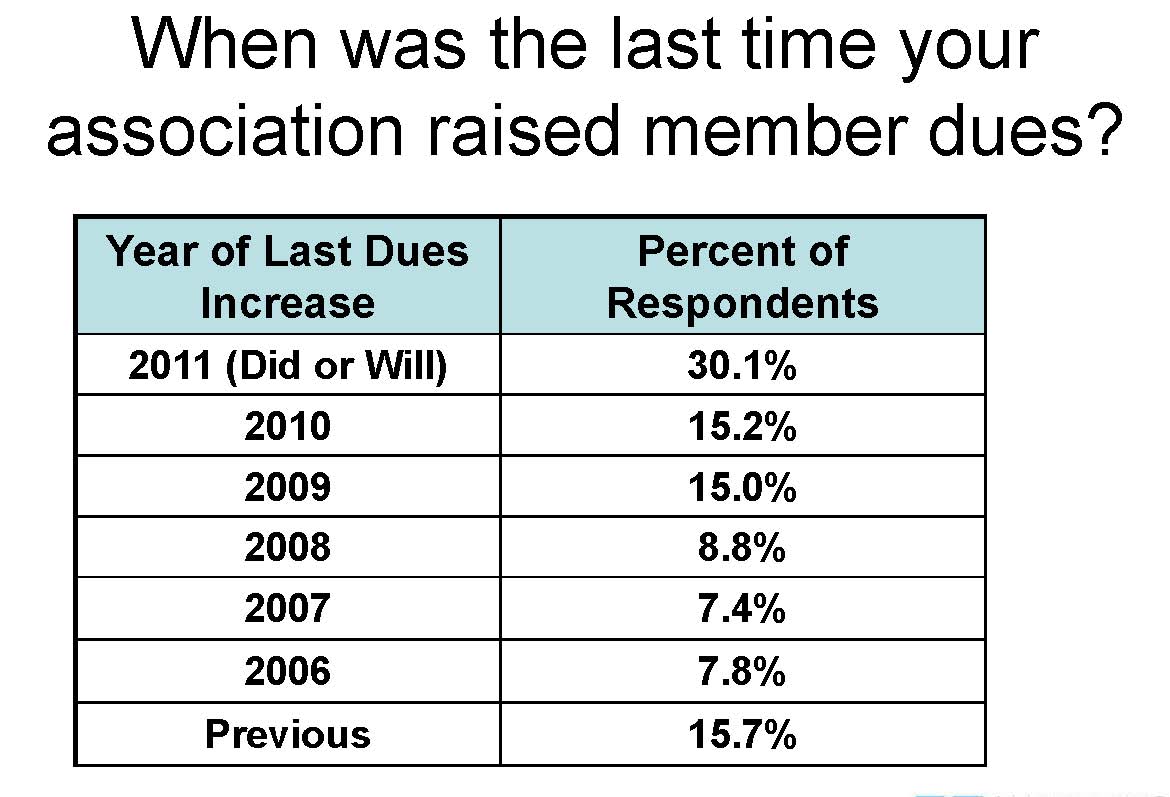
In our research, we asked: “How often does your association raise membership dues?”, “When was the last time your association raised membership dues?” and “What was the average percentage of your last membership dues increase across all membership categories?”
Here is how participations responded.
| Analyzing Two Volumes of Great Data |
In our research, we asked: “How often does your association raise membership dues?”, “When was the last time your association raised membership dues?” and “What was the average percentage of your last membership dues increase across all membership categories?”
Here is how participations responded.
These dues related questions were also included in our 2007 Membership Dues Increase Study. So in addition to cross tabulating responses with membership outcomes, we will also provide some trend data in our benchmarking report.
By the way, participating organizations in this year’s research will receive their copy of the Membership Marketing Benchmarking Report in a few months.
Subscribe to:
Posts (Atom)